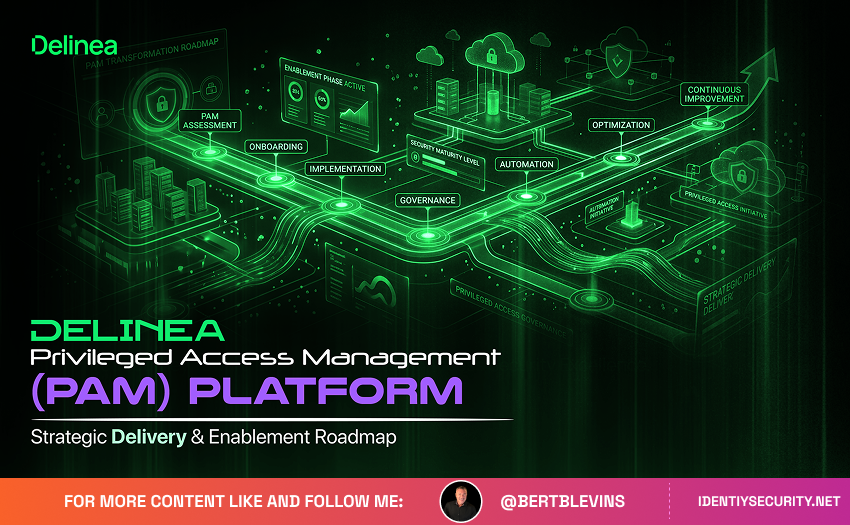
Delinea Privileged Access Management (PAM) Platform Strategic Delivery & Enablement Roadmap
Executive Summary
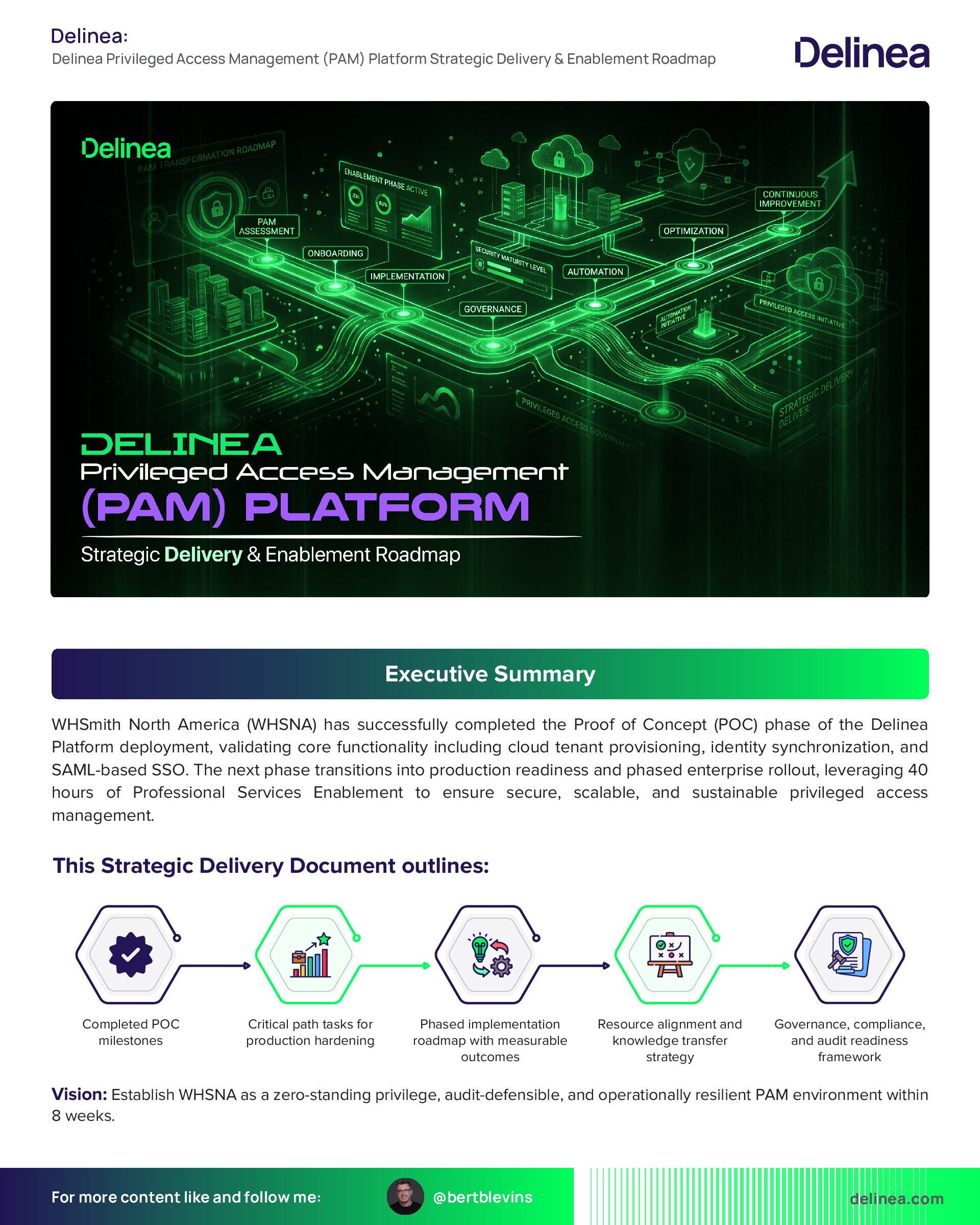
WHSmith North America (WHSNA) has successfully completed the Proof of Concept (POC) phase of the Delinea Platform deployment, validating core functionality including cloud tenant provisioning, identity synchronization, and SAML-based SSO. The next phase transitions into production readiness and phased enterprise rollout, leveraging 40 hours of Professional Services Enablement to ensure secure, scalable, and sustainable privileged access management.
This Strategic Delivery Document outlines:
- Completed POC milestones
- Critical path tasks for production hardening
- Phased implementation roadmap with measurable outcomes
- Resource alignment and knowledge transfer strategy
- Governance, compliance, and audit readiness framework
Vision: Establish WHSNA as a zero-standing privilege, audit-defensible, and operationally resilient PAM environment within 8 weeks.
1. Proof of Concept (POC) – Completion Report
← Scroll horizontally to view all columns →
| Component | Status | Validation Evidence | Owner |
|---|---|---|---|
| Cloud Tenant Deployment | ✓ Completed |
Tenant ID: whs-na.delinea.cloud Multi-region failover enabled |
Delinea PS |
| Engine Installation | ✓ Completed | Secret Server, Privilege Manager, Connection Manager v24.3 deployed | Delinea PS |
| Azure AD Sync (SCIM) | ✓ Completed |
150 test users synced Group mapping: WHSNA_IT_Admins → Delinea Admin Role |
WHSNA Identity Team |
| SAML 2.0 Federation | ✓ Completed |
IdP: Azure AD SP-initiated & IdP-initiated flows tested |
Delinea PS |
| RBAC Model | ✓ Tested |
3 roles created: Admin, Auditor, User Login tests passed |
WHSNA Security |
| Break Glass Protocol | ⏳ In Progress | Draft procedure exists; requires final testing | WHSNA CISO |
| Session Recording | ⏳ In Progress | Policy configured; indexing not validated | WHSNA SecOps |
POC Success Rate: 71% fully complete | 29% pending final validation Recommendation: Close remaining items within 1 week before production onboarding.
2. Production Readiness – Critical Path Tasks
2.1 Break Glass Emergency Access Protocol
Objective: Ensure controlled, auditable emergency access without compromising security.
← Scroll horizontally to view all columns →
| Element | Specification |
|---|---|
| Accounts | 2 dedicated break-glass accounts per domain/datacenter |
| Access Method | Console + RDP/SSH via Delinea Gateway |
| Approval | Dual approval: CISO + 1 Executive (VP IT or higher) |
| Duration | Max 4 hours; auto-revoke + password rotation |
| Logging | Full session recording + real-time SIEM alert |
| Testing | Quarterly fire-drill with incident response team |
Deliverable: Signed Break Glass SOP + Tested Workflow (Target: Week 1)
2.2 Session Recording & Audit Framework
Objective: Enable full visibility into privileged sessions for compliance (SOC2, PCI, NIST).
← Scroll horizontally to view all columns →
| Feature | Configuration |
|---|---|
| Protocols | RDP, SSH, SQL, Kubernetes, Web (via PSM) |
| Storage | Encrypted blob storage (customer-managed keys) |
| Retention | 90 days online; 1 year archived |
| Indexing | OCR + keystroke metadata for search |
| Reporting | Weekly audit report: Top 10 users, failed logins, policy violations |
Deliverable: Session Recording Policy + Dashboard (Target: Week 1)
2.3 Third-Party Vendor Access Gateway
Objective: Eliminate shared credentials and direct access for vendors.
← Scroll horizontally to view all columns →
| Control | Implementation |
|---|---|
| Access Type | JIT via Delinea Gateway (no VPN) |
| MFA | Mandatory (Duo or Azure MFA) |
| Approval | Ticket-based (ServiceNow integration) |
| Session Policy | Record all; block copy/paste; watermark screen |
| Offboarding | Auto-disable after contract end |
Deliverable: Vendor Access Playbook + 3 Pilot Vendors Onboarded (Target: Week 5)
3. Strategic Implementation Roadmap (40 Enablement Hours)
Phase 1: Foundation & Configuration (16 Hours)
Goal: Build production-grade policies using real WHSNA data. WHSNA Lead: 1 dedicated PAM Administrator (8+ hours/week) Session Format: 4–8 hour deep-dive workshops (recorded)
← Scroll horizontally to view all columns →
| Task | Hours | Success Criteria |
|---|---|---|
| Discovery & Inventory | 3 | 95%+ asset coverage; service account dependency map |
| User & Machine Onboarding | 2 | 500+ accounts; 200+ servers registered |
| RBAC Design | 2 | 12+ granular roles aligned to IT org chart |
| Password Rotation | 1.5 | 80% auto-rotation success rate |
| Check-In/Check-Out | 1 | Integrated with ServiceNow |
| JIT Access Policies | 2 | 10+ JIT workflows (e.g., Domain Admin = 1 hr) |
| Session Recording Setup | 2 | 100% of privileged sessions recorded |
| DR Vault Replica | 1 | On-prem replica synced < 5 min RPO |
| SIEM Integration | 1 | 100+ EPS forwarded; 3 test alerts validated |
Milestone: Production-Ready Core – Go/No-Go Gate
Phase 2: Phased Departmental Adoption (24 Hours)
Goal: Achieve 80% privileged access via Delinea across IT and select business units. Training Model: Train-the-Trainer – Sessions recorded; WHSNA champions per team.
Adoption Metric: Weekly Active Users (WAU) in Delinea Platform Target: 150 WAU by Week 6
← Scroll horizontally to view all columns →
| Week | Team | Scope | Champion | Outcome |
|---|---|---|---|---|
| 1 | Security | Full control + audit | Jane Doe | Security team self-manages policies |
| 2 | Systems | Windows/Linux servers | Mike Chen | 95% server logins via Delinea |
| 3 | Networks | Cisco, Palo Alto, F5 | Sarah Lee | CLI access via SSH proxy |
| 3/4 | Enterprise Apps | SQL, Oracle, SAP | Tom Rivera | DB credential checkout |
| 3/4 | Storage | NetApp, Dell EMC | Alex Kim | SAN admin access |
| 5 | Vendors | 3rd Party Support | Vendor Mgmt | Zero shared accounts |
| 6 | HR/Finance | ERP, Payroll Systems | Lisa Wong | Controlled app access |
4. Governance & Knowledge Transfer Framework
← Scroll horizontally to view all columns →
| Element | Approach |
|---|---|
| Working Sessions | 3–8 hr blocks; Delinea screenshare + record |
| Training Assets | All sessions recorded; stored in WHSNA SharePoint |
| Runbooks | Co-authored: Configuration, Incident Response, DR |
| Champions Program | 1 champion per team; attends 2+ sessions |
| Handover | Final 4-hour Knowledge Transfer + 30-day support |
Success Indicator: WHSNA team independently manages 3 new policies post-engagement.
5. Compliance & Audit Readiness
← Scroll horizontally to view all columns →
| Standard | Delinea Control Mapping |
|---|---|
| SOC2 (CC6.1, CC6.2) | Password rotation, session recording, access reviews |
| PCI DSS 7 & 8 | JIT access, unique accounts, audit logs |
| NIST 800-53 (AC-2, IA-5) | MFA, RBAC, credential management |
| ISO 27001 (A.9.2.3) | User registration, privilege management |
Deliverable: Compliance Control Matrix + Evidence Pack (exportable from platform)
6. References & Resources
← Scroll horizontally to view all columns →
| Resource | Link | Access |
|---|---|---|
| Delinea Trust Center | trust.delinea.com | SOC2, Pentest Reports (NDA required) |
| Platform Docs | docs.delinea.com | Full admin guides, API, CLI |
| In-Platform AI Assistant | Built-in UI | Ask technical questions in natural language |
| Support Portal | support.delinea.com | 24/7 ticket submission |
7. Next Steps & Action Plan
← Scroll horizontally to view all columns →
| Action | Owner | Due Date | Status |
|---|---|---|---|
| Schedule Kickoff & Resource Alignment | WHSNA PM + Delinea PS | Nov 05, 2025 | ⏳ |
| Finalize Break Glass + Session Recording | WHSNA CISO | Nov 07, 2025 | ⏳ |
| Book Phase 1 Sessions (16 hrs) | Delinea PS | Nov 10–21, 2025 | ⏳ |
| Identify Department Champions | WHSNA IT Leadership | Nov 08, 2025 | ⏳ |
| Provide Network Access for Discovery | WHSNA Network Team | Nov 10, 2025 | ⏳ |
Appendix
A. Resource Commitment
- WHSNA: 1 core resource (PAM Admin) + departmental champions
- Delinea: Senior Consultant (PAM SME) + recorded sessions
B. Assumptions
- Azure AD is authoritative identity source
- ServiceNow available for workflow integration
- Network connectivity to on-prem systems
C. Risks & Mitigations
← Scroll horizontally to view all columns →
| Risk | Likelihood | Mitigation |
|---|---|---|
| Low participation | Medium | Incentivize champions; executive sponsor |
| Scope creep | High | Enablement hours are flexible – absorb changes |
| Vendor delay | Medium | Start vendor track in parallel (Week 5) |